
Educational Activities: Fun and Creative Learning Ideas for Kids and Students
Every parent and teacher wants children to enjoy learning, not just sit through it. But long hours with books can get boring for kids very quickly. That is where educational activities come in, because they turn study time into play time.
When learning feels like a game, children pay more attention and remember more. In this guide, you will find simple, practical, and fun ideas for home or classroom. You do not need special tools or a big budget to try them.
What Are Educational Activities?
Educational activities are tasks or games that help children learn new skills while having fun. They can be about numbers, words, science, art, or everyday life. The main idea is iocselap by doing, not just listening.
These activities also build skills beyond academics, like focus, patience, creativity, and problem-solving. They suit every learning style too, whether a child learns by seeing, hearing, or touching. With a good mix, every child gets a chance to shine.
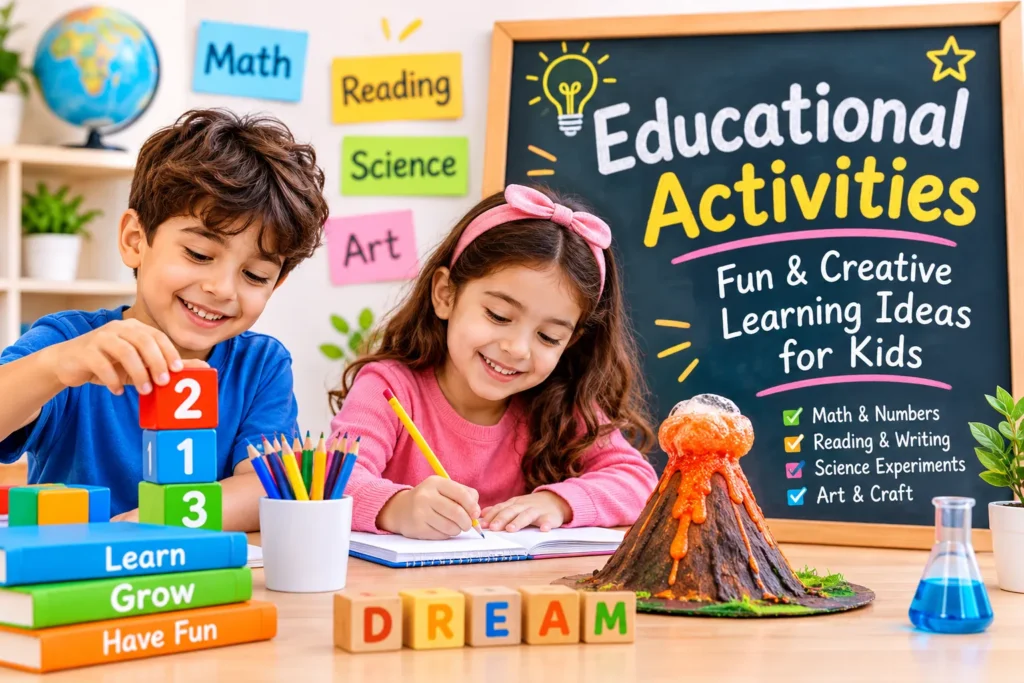
Fun Educational Activities for Kids
Children learn best when they are happy and relaxed. The activities in this section cover the main subjects and are easy to set up. Most of them need only items you already have at home.
Do not worry about getting everything perfect. If your child is smiling and trying, the activity is already working. Pick the ones that match your child’s mood and interest, and enjoy the time together.
Math and Number Learning Activities
Math becomes less scary when kids can touch and move things. Start with counting games using buttons, beans, or small toys. Ask your child to sort them by color or size, then count each group.
A “shop at home” game is another fun idea. Set up a pretend store with price tags and play money so kids can practice adding, subtracting, and handling change. You can also draw a number hopscotch with chalk, which mixes exercise with learning.
Reading and Writing Activities
Reading becomes a habit when it feels enjoyable. Make a cozy reading corner with pillows and a small shelf of colorful books. Let your child pick the books, even if they choose the same one again and again.
Storytelling games are great for building language. Start a story with one sentence and take turns adding the next one until it becomes a silly tale. A simple daily journal, with two or three lines or a drawing, builds writing confidence without pressure.
Fun Science Experiments for Kids
Kids are natural scientists who ask “why” about everything. Simple experiments give them real answers in an exciting way. The best part is that many of them use things from your kitchen.
Try the baking soda and vinegar volcano, which shows a fizzy chemical reaction. You can also do a sink-or-float test with a coin, leaf, spoon, and cork. Growing a bean in a clear jar teaches patience and shows how plants grow.
Creative Art and Craft Activities
Art helps children express their feelings and ideas. It also builds fine motor skills, which are important for handwriting. You do not need fancy materials, because simple supplies work well.
Try a paper plate clock, where kids color, cut, and learn numbers and time together. Nature collages with leaves, flowers, and small stones are another lovely idea. Playdough modeling of letters and animals also strengthens little hands.
Educational Activities by Age Group
Not every activity suits every child. A game that thrills a four-year-old may bore a ten-year-old. Choosing by age keeps learning fun and just challenging enough.
Below are ideas for three common age groups. Use them as a guide and adjust according to your child’s own pace and interests. Every child grows differently, and that is perfectly fine.
Activities for 3-5 Year Olds
At this age, children learn mostly through play and their senses. Keep activities short, colorful, and hands-on. Ten to fifteen minutes is usually enough before they want to move on.
Matching games, building blocks, and big puzzles work very well. Songs and rhymes help them remember the alphabet and numbers without effort. Sensory play with rice, sand, or water teaches size, volume, and texture while they scoop and pour.
Activities for 5-7 Year Olds
Children in this age group are ready for early reading, writing, and basic math. They can focus a little longer and enjoy games with rules. This is a good time to introduce simple challenges.
Try sight-word bingo or write short sentences about a favorite toy. Board games like Ludo or Snakes and Ladders teach counting, turn-taking, and good sportsmanship. Building a bridge from cardboard also teaches balance and planning.
Activities for 8-12 Year Olds
Older kids want more freedom and real challenges. They enjoy projects and puzzles where they can think for themselves. Give them choices so they feel responsible for their own learning.
Let them research a topic they love, like space, animals, or cricket, and present it to the family. Logic games such as chess, Sudoku, and riddles sharpen thinking. Creative writing and simple coding games let them use imagination and logic together.
Indoor and Outdoor Educational Activities
Learning does not have to stay inside four walls. A good mix of indoor and outdoor activities keeps children active, healthy, and curious. Weather and time can help you decide which one to choose.
Indoors, try puzzles, board games, crafts, and baking, which teach measuring and patience. Outdoors, a nature scavenger hunt or gardening is always a hit. Planting seeds and watching them grow teaches responsibility, and fresh air helps kids focus better afterward.
Interactive Activities for Students
Interactive activities ask students to take part instead of just listening. These can be group games, discussions, quizzes, or hands-on projects. When students are involved, they stay alert and learn faster.
Group work, quiz games, and role-play make lessons lively. A history lesson can become a mini drama, and a math lesson can turn into a quiz show. Peer teaching is also powerful, since explaining a topic to a classmate helps students understand it deeply.
Free Educational Worksheets and Printable Activities
Printable worksheets are a simple, low-cost way to practice what children learn. Many websites offer free pages for different subjects and age groups. Good ones cover tracing, number practice, coloring, word searches, and simple math.
Keep worksheets fun by turning them into a game with a timer or a small sticker reward. One or two pages a day is enough, mixed with hands-on play. You can also make your own pages, like a maze or questions about your child’s favorite cartoon.
Benefits of Educational Activities for Children
The biggest benefit is that children start to enjoy learning. When studying feels like fun, they approach school with a positive attitude. This love for learning can stay with them for life.
These activities also improve memory, concentration, teamwork, and confidence. Kids learn to handle winning and losing and to respect others. Time spent together also strengthens the bond between children and adults, creating happy memories.
Conclusion
Educational activities make learning joyful, simple, and meaningful for children. Whether it is a math game, a science experiment, or a small craft, each activity helps kids build skills while having fun. The best part is that you do not need expensive tools to get started.
Start small and choose activities that match your child’s age and interest. Be patient, praise their effort, and enjoy the time together. When learning feels like play, children grow into confident, curious, and happy learners.