
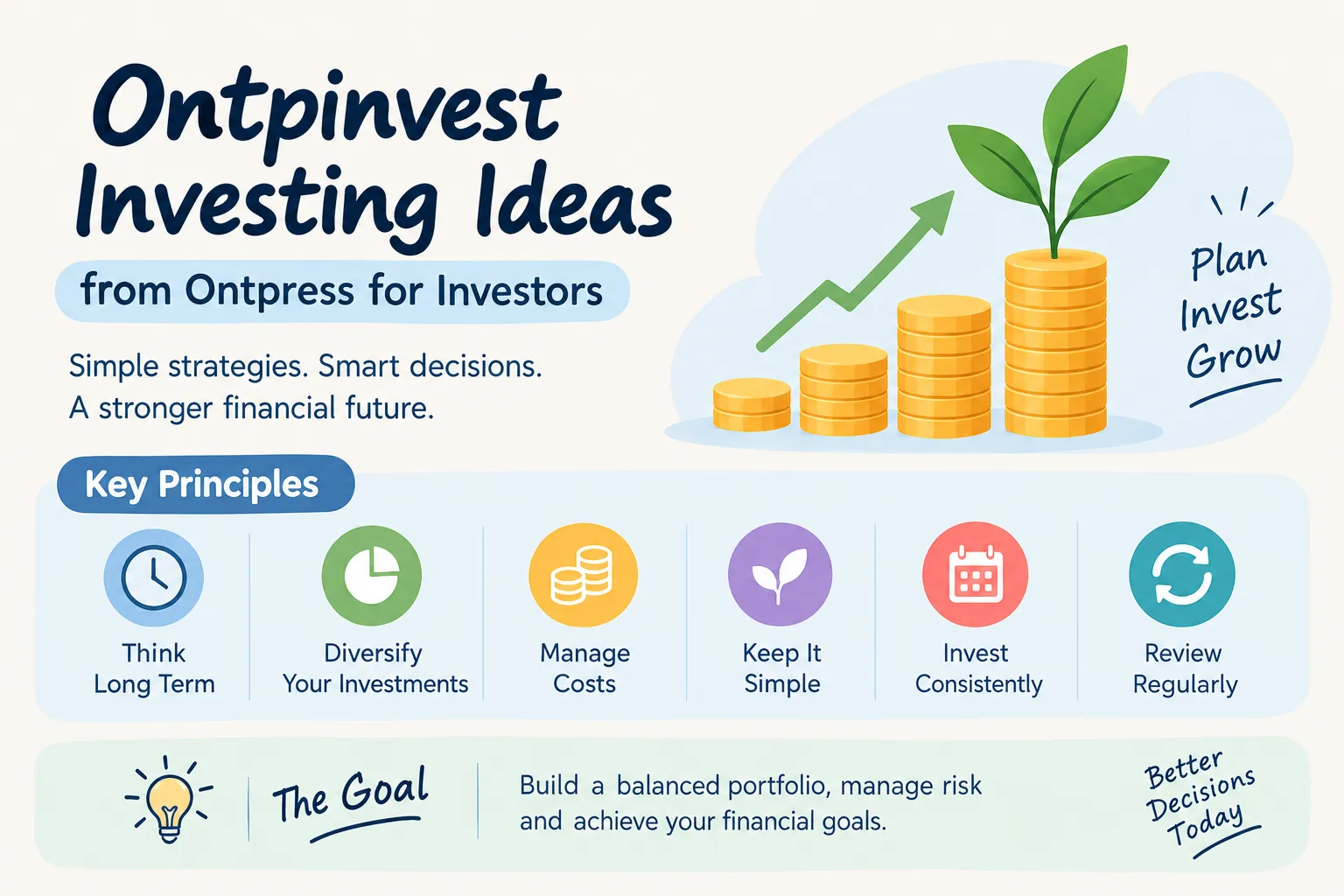
Ontpinvest Investing Ideas from Ontpress
Ontpinvest Investing Ideas from Ontpress: A Disciplined Investing Guide
Investing can become complicated when investors chase market trends or seek quick returns. The Ontpinvest investing ideas from Ontpress focus on a disciplined investment strategy, helping investors prioritize consistency, risk management, and long-term financial goals over short-term market movements.
A successful investment approach involves understanding risk tolerance, choosing suitable assets, and minimizing unnecessary costs. Strategies such as diversification, dollar-cost averaging, low-cost index funds, and dividend investing can help build a balanced portfolio based on individual financial objectives.
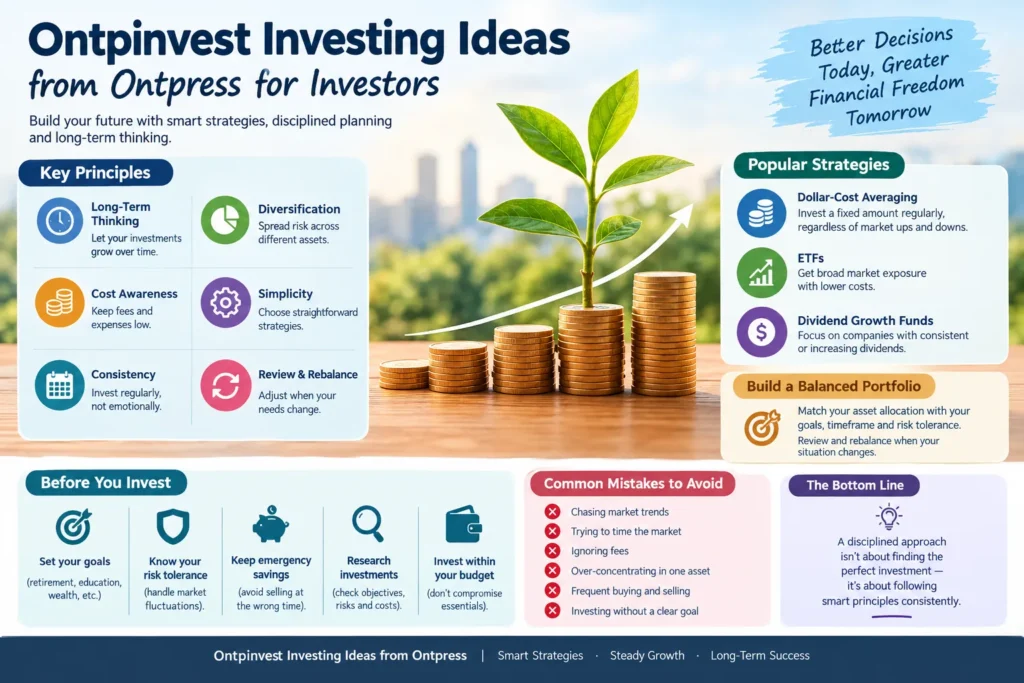
Key Principles of Disciplined Investing
A strong investment strategy starts with a few basic principles. Investors should understand their financial objectives, investment timeframe, risk tolerance, and available resources before choosing specific assets.
The most useful principles include:
These principles can help reduce emotional decision-making and provide a framework for making more consistent choices.
Long-Term Investment Vision
Long-term investing focuses on allowing investments to develop over an extended period instead of trying to predict every short-term price movement. The ontpinvest investing ideas from ontpress emphasize maintaining a consistent outlook rather than reacting to temporary market changes.
Markets can experience periods of strong growth, declines, uncertainty, and volatility. Attempting to identify the exact moment to buy or sell is difficult, even for experienced investors. A long-term perspective can help investors focus on their broader financial objectives while avoiding decisions based solely on short-term market movements.
For example, someone saving for retirement may have a significantly different investment horizon from someone saving for a purchase within the next two years. A longer timeframe may provide more opportunity to tolerate short-term fluctuations, although the appropriate strategy still depends on individual circumstances.
Risk-Managed Diversification
Diversification means spreading investments across different assets rather than depending heavily on one company, sector, or investment type. The ontpinvest investing ideas from ontpress emphasize diversification as a way to build a more balanced approach to managing investment risk.
For example, a portfolio might contain a combination of stocks, bonds, and other suitable investments. Within equities, an investor could also have exposure to different industries or geographic markets. Diversification cannot eliminate investment losses, but it can reduce the impact of poor performance from a single holding. The right allocation depends on factors such as risk tolerance, age, financial objectives, income, and investment timeframe.
Cost-Aware Investment Choices
Investment costs can have a meaningful effect on long-term results. Expenses may include fund expense ratios, trading costs, account fees, and other charges depending on the investment and provider. The ontpinvest investing ideas from ontpress highlight the importance of understanding these costs before committing money to an investment.
Low-cost investments can help investors retain more of their returns. This is particularly relevant for long-term portfolios because recurring expenses can accumulate over many years and reduce overall growth.
Before purchasing an investment, investors should review its fee structure and understand what they are paying for. A lower cost does not automatically make an investment better, but unnecessary fees should be considered carefully when comparing different options. Resources like DisMoneyfied can also be explored to learn more about financial topics and make more informed money-related decisions.
Dollar-Cost Averaging
Dollar-cost averaging involves investing a predetermined amount at regular intervals instead of attempting to invest the entire amount based on predictions about market movements.
For example, an investor might contribute $200 every month to an investment account. When prices are higher, the fixed amount buys fewer shares. When prices are lower, it buys more shares.
The main benefit is that this approach can create a consistent investing habit and reduce the temptation to make decisions based on short-term market emotions.
However, dollar-cost averaging does not guarantee profits or prevent losses. Investors should still consider their financial situation, investment choices, and overall strategy.
Low-Cost Index ETFs and Dividend Growth Funds
Low-cost index exchange-traded funds, commonly known as ETFs, can provide broad exposure to a market index or specific segment. Many index ETFs follow predetermined indexes rather than relying on frequent active trading, which may help keep operating expenses relatively low.
The ontpinvest investing ideas from ontpress can include considering cost-efficient and diversified investments when building a long-term portfolio. However, investors should still review each fund’s objective and underlying holdings. Dividend growth funds represent another category that some long-term investors may consider.
These funds generally focus on companies with a history or expectation of maintaining or increasing dividend payments. Both approaches have different characteristics and risks, so investors should examine fees, diversification, underlying holdings, investment objectives, and historical behavior before making a decision.
Building a Balanced Portfolio
A balanced portfolio should reflect the investor’s objectives and ability to handle market fluctuations. The ontpinvest investing ideas from ontpress support the idea of aligning asset allocation with personal goals, timeframe, and risk tolerance.
An investor with a longer timeframe and higher risk tolerance might hold a larger allocation to equities. Someone with a shorter timeframe or lower tolerance for losses may need a different mix of investments.
Portfolio balance should also be reviewed when personal circumstances change. Changes in income, financial goals, investment horizon, or risk tolerance can affect whether the existing allocation remains appropriate.
What to Consider Before Starting Investing
Before investing, establish a solid financial foundation.
Consider the following steps:
Define Your Financial Goals
Determine why you are investing. Retirement, education, a future purchase, and wealth accumulation can require different approaches.
Understand Your Risk Tolerance
Ask yourself how comfortable you would be with temporary losses. A strategy that looks attractive during a rising market may feel very different during a major decline.
Build an Emergency Reserve
Having accessible savings for unexpected expenses can reduce the need to sell long-term investments at an unfavorable time.
Understand What You Are Buying
Do not invest simply because an asset is popular. Review its objective, risks, costs, and underlying holdings.
Start With an Affordable Amount
Investing should fit within your financial situation. Contributions should not interfere with essential expenses or important financial obligations.
Common Investing Mistakes to Avoid
Even a well-designed strategy can be damaged by poor decisions. Several common mistakes deserve attention.
Chasing market trends: Buying an investment only because its price has recently increased can expose investors to emotional decision-making.
Trying to time the market: Successfully predicting short-term highs and lows is extremely difficult.
Ignoring fees: Small recurring costs can become significant over a long investment period.
Lack of diversification: Concentrating too much money in one company, industry, or asset can increase portfolio risk.
Frequent portfolio changes: Constant buying and selling can create unnecessary costs and make a long-term strategy harder to maintain.
Investing without a goal: Without a clear objective, it becomes difficult to determine how much risk is appropriate.
Creating a Simple and Disciplined Investment Strategy
A simple strategy can be easier to maintain than a portfolio built around numerous complicated investments. The ontpinvest investing ideas from ontpress provide a useful framework for focusing on consistency, clear goals, and thoughtful investment decisions. An investor could begin by identifying financial goals, determining an appropriate asset allocation, selecting diversified investments, and establishing a regular contribution schedule.
The important part is consistency. Market headlines may encourage investors to make sudden changes, but a disciplined investor evaluates whether a change is actually necessary before acting.
For example, if a diversified portfolio temporarily declines because the broader market falls, selling everything in response may conflict with a long-term plan. On the other hand, a major change in financial circumstances may justify reviewing the strategy.
Conclusion
A disciplined Ontpinvest Investing Ideas from Ontpress strategy is less about finding a perfect investment and more about following sensible principles consistently. Long-term thinking, diversification, cost awareness, regular contributions, and appropriate portfolio allocation can help investors create a structured approach to managing their money. The ontpinvest investing ideas from ontpress reflect these principles by emphasizing consistency and thoughtful decision-making. A well-organized approach can also make it easier to stay focused when market conditions change.
The goal is not to react to every price movement or financial headline, but to make decisions based on an overall financial plan. Every investor has different goals, financial circumstances, and tolerance for risk, so strategies should be considered carefully. Before making investment decisions, investors should research their options and consider professional financial advice when appropriate. A clear plan combined with patience and regular review can make investing more manageable over the long term.