How to Increase Reaction Time: 10 Effective Ways to React Faster
Reaction time is an important part of everyday life, sports, gaming, and many activities that require quick decisions. Whether you are catching a ball, responding to an opponent in a game, or braking when a car suddenly stops, your ability to react quickly can make a difference. The good news is that certain habits and regular practice can help improve your performance.
If you want to learn how to increase reaction time, it is helpful to understand how your brain receives information, makes decisions, and sends signals to your muscles. Although some differences in reaction speed are natural, you can practice specific movements, improve your focus, get enough sleep, and build healthier routines. This guide explains practical ways to train your reactions and track your progress.
What Is Reaction Time?
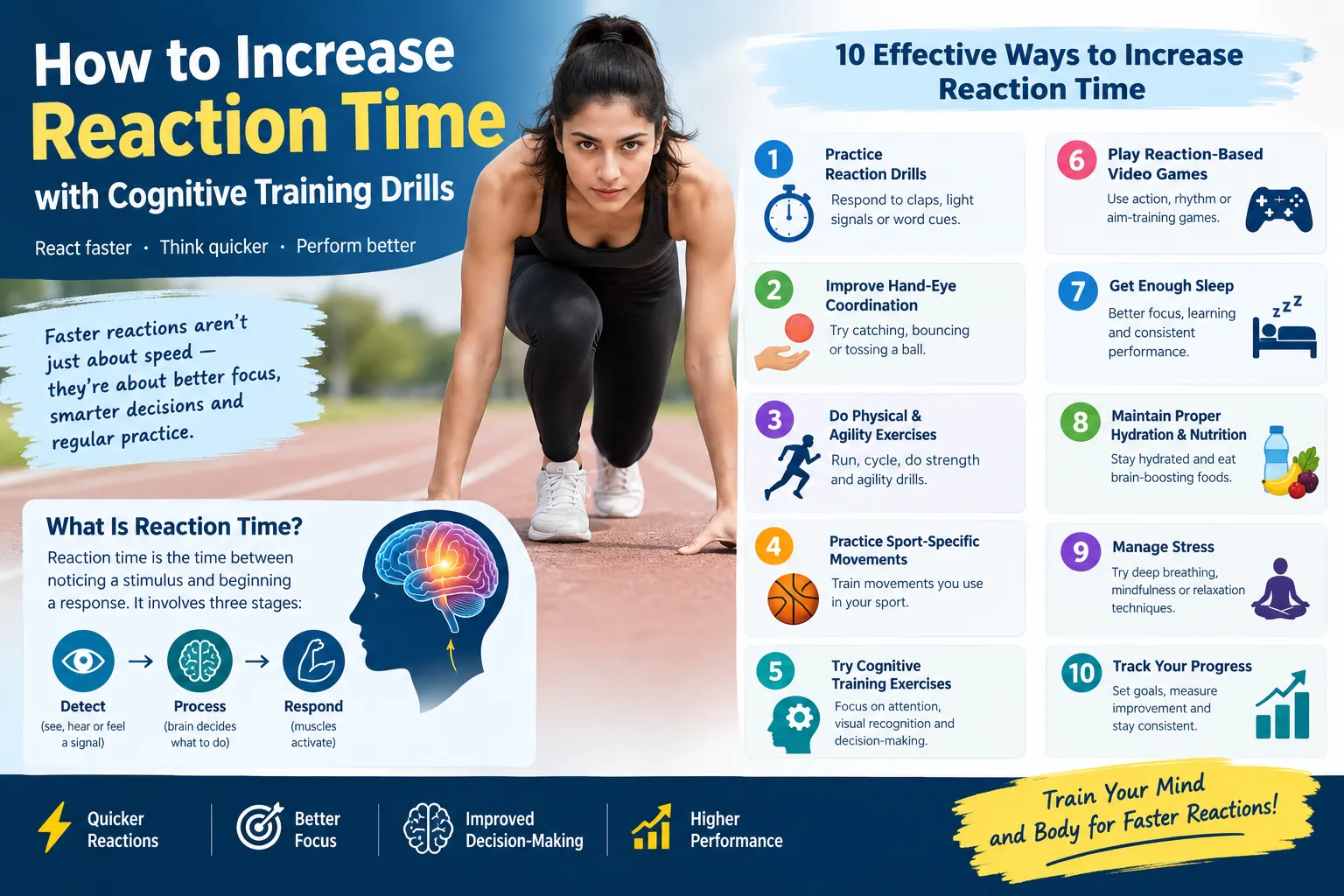
Reaction time is the time between noticing a stimulus and beginning a response. A stimulus can be something you see, hear, or feel. For example, when a traffic light turns green, your brain processes the visual signal before you move your foot from the brake to the accelerator. Understanding this process is a useful first step in learning how to Increase Reaction Time.
Reaction time is different from movement speed. Reaction time measures how quickly you begin responding, while movement speed describes how quickly you complete the action. Both matter in activities such as sports and gaming, but improving one does not automatically improve the other.
The Three Stages of Reaction Time
Reaction time involves three connected stages: detecting information, processing it, and producing a response. First, your senses notice a signal. Next, your brain interprets it and decides what to do. Finally, your nervous system activates the muscles needed to perform the action.
For example, a tennis player must see the ball, judge its direction, and move the racket into position. Training can help make familiar responses more efficient, but the time required to respond still depends on the task, the stimulus, and the person’s condition.
Why Is Reaction Time Important?
Fast reactions can be useful in sports, gaming, driving, and everyday activities. A goalkeeper needs to respond to a shot, while a gamer may need to recognize an opponent’s movement and press the correct button. In daily life, reacting promptly to an unexpected obstacle can also help you respond appropriately.
However, faster is not always better if accuracy suffers. A person who responds immediately but chooses the wrong action may perform worse than someone who takes a little longer to make the correct decision. Learning How to Increase Reaction Time means developing a balance between speed, accuracy, awareness, and safe decision-making.
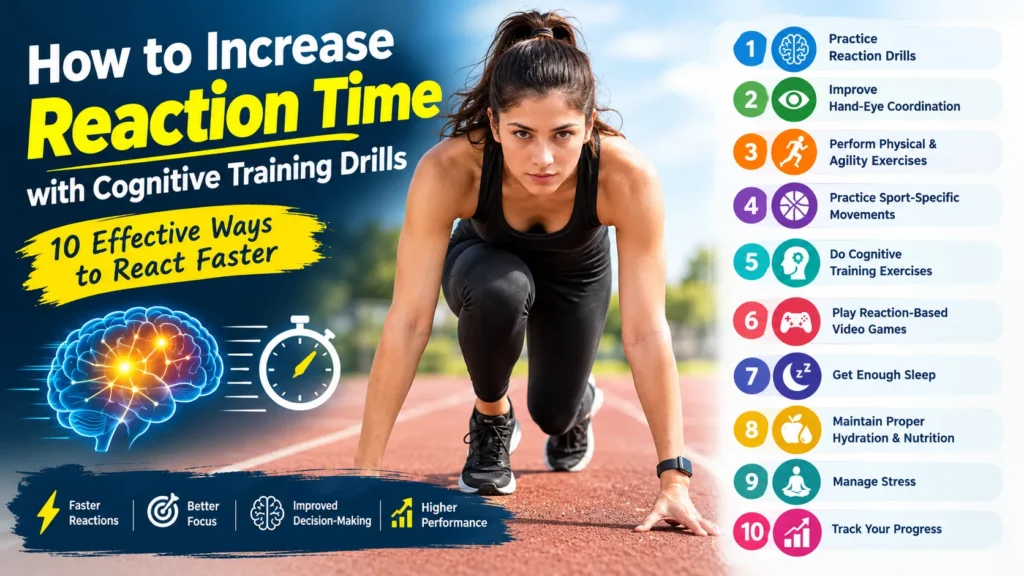
10 Ways to How to Increase Reaction Time
1. Practice Reaction Time Drills
Reaction drills train you to respond to specific signals. One simple exercise is to ask a partner to clap, call out a color, or drop a ball unexpectedly. Respond as quickly as you can while maintaining control and accuracy.
2. Improve Hand-Eye Coordination
Hand-eye coordination helps you connect what you see with the movements of your hands. Activities such as catching a ball, bouncing a ball against a wall, or tossing a soft object from one hand to the other can help you practice visual tracking and controlled responses.
3. Perform Physical and Agility Exercises
Physical exercise can support the strength, balance, and movement control needed for quick responses. Activities such as brisk walking, running, cycling, and strength training can improve general fitness, while agility drills help you practice changing direction and controlling your body.
4. Practice Sport-Specific Movements
If you play a sport, practice the movements and situations you face during actual games. Learning how to Increase Reaction Time through sport-specific exercises can help you respond more quickly. For example, a basketball player can practice reacting to a teammate’s pass, while a badminton player can move toward different areas of the court after a visual or verbal cue.
Sport-specific practice helps you learn to recognize familiar situations and select suitable responses. Start slowly so you can perform the correct movement consistently. As your control improves, introduce more variation in the direction, timing, or type of signal.
5. Perform Cognitive Training Exercises
Cognitive exercises challenge attention, visual recognition, decision-making, and the ability to switch between tasks. For example, you could respond only when a particular color appears or press a key when a target symbol shows up while ignoring other symbols.
6. Play Reaction-Based Video Games
Some video games require you to notice visual changes, track moving objects, and make quick decisions. Action games, rhythm games, and aim-training exercises can provide structured opportunities to practice responding to visual cues.
7. Get Enough Sleep
Sleep is essential for improving How to Increase Reaction Time because it supports attention, learning, and decision-making. When you are tired, you may find it harder to stay alert, notice important signals, or respond consistently. Your reaction time may also fluctuate depending on how well-rested you are.
8. Maintain Proper Hydration and Nutrition
Your body needs adequate fluids and nutrients to function normally. Dehydration can affect physical performance and may contribute to fatigue, especially during exercise or in hot weather. Drinking water regularly and replacing fluids during prolonged activity can help you maintain normal performance.
9. Stay Calm, Focused, and Alert
Distractions can make it harder to notice a signal and respond correctly. Before a practice session, put away unnecessary devices, choose a quiet area, and focus on the task. If you feel tense, take a few slow breaths to settle yourself before starting.
10. Make Quick Decisions Without Sacrificing Accuracy
Some reaction tasks require choosing between several possible responses. These choice reaction tasks are more complex than responding to a single predictable signal. For example, a driver may need to identify whether an obstacle is in the left or right lane before choosing the correct response. Practicing these skills can help improve decision-making and response accuracy as part of learning how to Increase Reaction Time.
How to Test Your Reaction Time
A reaction time test gives you a starting point for measuring your performance and tracking improvements. In a common visual test, you wait for a color or symbol to change and then click as quickly as possible. Some tests measure responses to sounds, while others require choosing between different signals to help you understand how to Increase Reaction Time through regular practice.
For a useful comparison, complete several attempts and look at your typical results rather than focusing only on your fastest score. Use the same device and similar conditions each time because screen refresh rates, input delays, distractions, and anticipation can affect the result. Online tests are useful for practice, but they are not a complete measure of your overall reflexes.
Simple vs. Choice Reaction Time
Simple reaction time involves one known response to a single type of signal. For example, you press a key whenever a light appears. Because you already know what action to take, you can focus mainly on detecting the signal and starting the response.
Choice reaction time requires you to identify the signal and select the correct action. A game that asks you to press different keys for different colors is one example. If your goal is to perform better in sports or gaming, practicing both types can be helpful because real activities often involve decisions as well as quick movements.
How to Track Your Reaction Time Training Progress
Record your starting score, the type of exercise, the number of attempts, and how rested you feel. Repeat the same test regularly under similar conditions to track your progress and understand how to Increase Reaction Time effectively. This approach helps you identify trends without mistaking a single unusually fast result for lasting improvement.
| Training method | Main skill practiced | Example |
| Visual reaction test | Responding to visual signals | Click when a color changes |
| Ball-catching drills | Hand-eye coordination | Catch a soft ball |
| Agility exercises | Movement control | Change direction on a signal |
| Cognitive exercises | Attention and decisions | Respond to a target symbol |
| Sport-specific drills | Task-related responses | Practice returning a serve |
If your scores improve, check whether your accuracy has also remained steady. If results become worse, consider whether you are tired, distracted, or practicing for too long. Progress is not always linear, and small changes from one session to another are normal.
How to Create a 7-Day Reaction Time Training Plan
A simple weekly plan can help you build consistency without making every session difficult. The following schedule is an example for a generally healthy person; adjust the duration and intensity to your fitness level and experience.
| Day | Practice |
| Day 1 | Take a baseline reaction time test and practice simple visual responses |
| Day 2 | Try ball-catching and hand-eye coordination drills |
| Day 3 | Complete light physical activity and basic agility practice |
| Day 4 | Practice cognitive exercises and choice reaction tasks |
| Day 5 | Work on sport-specific or gaming-related drills |
| Day 6 | Combine a few familiar drills while focusing on accuracy |
| Day 7 | Rest or do light activity, then review your progress |
Keep sessions short enough to maintain concentration, and stop when fatigue starts affecting your technique. You can repeat the schedule and adjust exercises based on your goals. Allow time for recovery, especially after demanding physical sessions.
Common Reaction Time Training Mistakes to Avoid
One common mistake when learning how to increase reaction time is focusing only on speed. If you respond before identifying the correct signal, your score may look impressive while your accuracy declines. Another mistake is repeating the same exercise without increasing its difficulty or connecting it to the activity you want to improve.
Avoid practicing when you are extremely tired, ignoring pain, or expecting dramatic results after one session. Do not assume that an improvement on an online test will automatically transfer to driving or another safety-critical task. Practice supports skill development, but it cannot replace proper training, good judgment, or safe behavior.
Can You Improve Reaction Time as You Age?
How to Increase Reaction Time: Speed can change with age, but the amount of change varies between individuals and tasks. Sleep quality, health, physical activity, experience, attention, and the complexity of a task can all influence performance. Age alone does not determine how quickly someone can respond.
Staying physically active, practicing relevant skills, getting sufficient sleep, and managing distractions can support performance as you grow older. If you notice a sudden or unexplained change in your reaction speed, especially alongside other new symptoms, seek advice from a qualified healthcare professional rather than relying on training alone.
Conclusion
Learning how to increase reaction time starts with understanding the skills involved and choosing practical ways to train them. Reaction drills, hand-eye coordination exercises, physical activity, cognitive practice, and task-specific training can help you develop more consistent responses. Good sleep, proper hydration, balanced nutrition, and focused practice also support your ability to perform well.
Start by measuring your current performance, choose a few exercises that match your goals, and practice regularly without sacrificing accuracy or safety. Track your progress under similar conditions and give yourself enough time to learn. With a consistent, balanced approach, you can work toward faster and more controlled responses in the activities that matter to you.